Performance Marketing
SEO vs Google Ads: Which Is Better for Your Business?
SEO vs Google Ads
When people search for products or services online, businesses need to be visible at the right time. Two of the most effective ways to achieve this are Search Engine Optimization (SEO) and Google Ads.
But which one is better for your business?
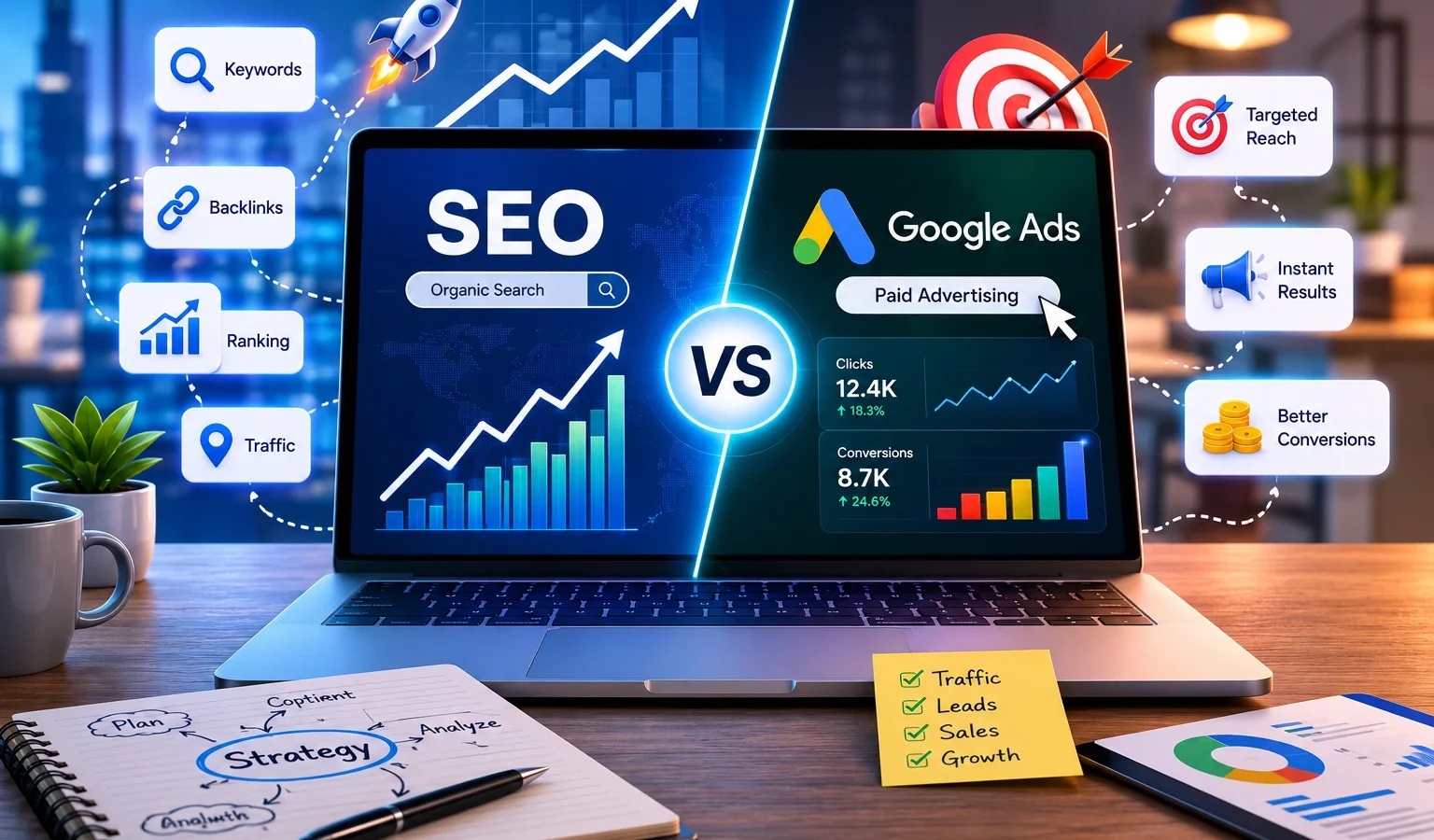
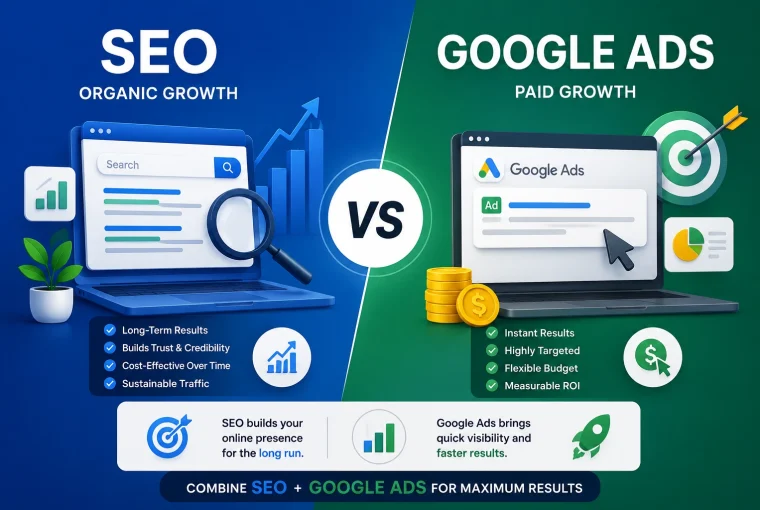
The answer isn’t the same for every business. SEO focuses on long-term organic growth, while Google Ads provides immediate paid visibility. Understanding the difference can help you choose the right digital marketing strategy based on your goals, budget, competition, and target audience.
In this guide, we’ll compare SEO vs Google Ads, explain the benefits of each, and show you when your business should use one—or both.
What Is SEO?
Search Engine Optimization (SEO) is the process of improving your website and online presence so that your pages appear higher in Google’s organic search results.
SEO focuses on attracting people who are already searching for products, services, or information related to your business.
A typical SEO strategy can include:
- Keyword research
- On-page SEO
- Technical SEO
- Content creation
- Local SEO
- Link building
- Website speed optimization
- Mobile optimization
- Conversion optimization
For example, a digital marketing agency may optimize its website for keywords such as “digital marketing agency in Hyderabad” or “SEO services in Hyderabad.”
When the website ranks organically for these searches, potential customers can discover the business without the company paying for every individual click.
What Is Google Ads?
Google Ads is Google’s paid advertising platform that allows businesses to display advertisements when people search for relevant keywords.
For example, if someone searches for “best digital marketing agency near me,” a business running a relevant Google Ads campaign may appear at the top of the search results.
Google Ads can help businesses generate:
- Website traffic
- Leads
- Phone calls
- Enquiries
- Online sales
- Bookings
- Brand awareness
Unlike SEO, Google Ads can provide visibility much faster, making it useful for businesses that want immediate opportunities.
SEO vs Google Ads: Key Differences
Although both strategies can help businesses attract customers from Google, they work differently.
| Factor | SEO | Google Ads |
| Traffic | Organic | Paid |
| Speed | Gradual | Faster |
| Long-Term Value | High | Depends on continued spending |
| Cost | Investment in optimization and content | Advertising spend + management |
| Visibility | Earned rankings | Paid placements |
| Best For | Sustainable growth | Immediate traffic and leads |
| Results | Usually take time | Can begin quickly |
| Maintenance | Ongoing optimization | Ongoing campaign management |
Let’s look at the major differences in more detail.
- SEO Builds Long-Term Organic Visibility
One of the biggest advantages of SEO is its long-term potential.
When your website earns strong organic rankings for relevant keywords, it can continue attracting visitors over time.
For example, a well-optimized service page that ranks for a valuable search term can generate traffic and enquiries for months or even years.
However, SEO is not a one-time activity. Search rankings can change because of competitors, algorithm updates, changing search behaviour, and website changes.
Consistent optimization is therefore important for maintaining organic visibility.
- Google Ads Can Deliver Faster Results
SEO generally takes time to build.
Google Ads can provide a much faster route to visibility because businesses can bid on relevant search terms and display advertisements to potential customers.
This can be particularly useful when you are:
- Launching a new business
- Promoting a new product
- Running a limited-time offer
- Generating leads
- Entering a competitive market
- Testing a new service
For businesses that need enquiries quickly, Google Ads can be an effective part of the marketing strategy.
- SEO Helps Build Brand Authority
Organic search visibility can contribute to your brand’s credibility.
When your website consistently appears in Google’s organic results for relevant searches, users may become more familiar with your business.
SEO also allows businesses to create useful content that answers customer questions and demonstrates expertise.
For example, a company offering financial services could publish educational content around financial planning, investment basics, or business finance.
This can help attract visitors while strengthening the brand’s online presence.
- Google Ads Provides Precise Targeting
Google Ads gives businesses significant control over where and when advertisements appear.
Depending on the campaign, businesses can target audiences based on factors such as:
- Keywords
- Location
- Language
- Device
- Audience signals
- Search intent
- Remarketing audiences
This allows businesses to focus their advertising budget on users who are more likely to become customers.
For local businesses, location targeting can be particularly valuable.
For example, a Hyderabad-based service provider can focus its campaigns on customers searching for its services within selected locations.
- SEO Can Reduce Dependence on Paid Traffic
With Google Ads, your visibility is directly connected to your advertising budget.
When campaigns stop, your paid search traffic generally stops as well.
SEO works differently.
Once your website earns valuable organic rankings, it can continue receiving search traffic without paying Google for every click.
This doesn’t mean SEO is free. Businesses still need to invest in content, technical optimization, strategy, and ongoing maintenance.
However, successful SEO can create a valuable long-term marketing asset.
- Google Ads Provides Measurable Campaign Data
Google Ads provides detailed performance information that can help businesses understand how their advertising investment is performing.
You can track metrics such as:
- Impressions
- Clicks
- Click-through rate
- Cost per click
- Conversions
- Cost per conversion
- Conversion value
- Return on ad spend
This data allows businesses to identify which campaigns, keywords, advertisements, and landing pages are producing better results.
With proper conversion tracking, Google Ads can become a highly measurable customer acquisition channel.
- SEO Requires Consistency and Patience
SEO is a long-term strategy.
Businesses shouldn’t expect a new website or newly published page to immediately reach the top of Google.
Results depend on several factors, including:
- Keyword competition
- Website authority
- Content quality
- Technical SEO
- Backlinks
- Search intent
- Competitor activity
- Website history
This is why successful SEO requires a consistent strategy rather than short-term optimization.
- Google Ads Requires Continuous Budget
Google Ads can generate traffic quickly, but it requires ongoing advertising investment.
The cost of clicks varies depending on the keyword, industry, competition, location, and other factors.
A campaign can also become expensive if it is poorly managed.
Common issues include:
- Targeting irrelevant keywords
- Poorly written advertisements
- Weak landing pages
- Incorrect conversion tracking
- Broad targeting
- Poor budget allocation
Professional campaign management can help reduce wasted spending and improve campaign efficiency.
SEO vs Google Ads: Which Is Better for Different Businesses?
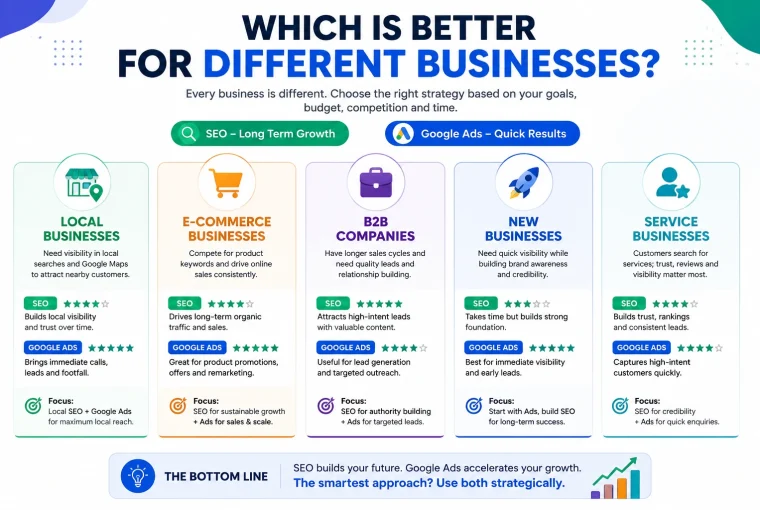
There is no single answer that works for every business.
Your ideal strategy depends on your objectives and business model.
For Local Businesses
Local businesses can benefit from both SEO and Google Ads.
Local SEO can help businesses appear in organic search results and Google Maps-related searches, while Google Ads can provide faster visibility for high-intent searches.
Restaurants, clinics, real estate companies, service providers, educational institutions, and local retailers can all benefit from a well-planned combination.
For E-Commerce Businesses
E-commerce businesses can use SEO to build organic product and category visibility while using Google Ads to promote products and capture purchase-ready customers.
Paid campaigns can also provide useful data about which products and search terms generate conversions.
For B2B Businesses
B2B companies often have longer sales cycles.
SEO can help them attract potential customers through educational content, service pages, industry topics, and problem-focused searches.
Google Ads can complement this by targeting high-intent keywords and supporting lead-generation campaigns.
For New Businesses
New businesses often need visibility quickly.
Google Ads can help generate initial traffic while SEO is developed in parallel.
This combination allows a business to pursue short-term opportunities without ignoring long-term organic growth.
For Service Businesses
Service businesses can benefit significantly from search marketing because potential customers often search Google when they are ready to enquire or make a purchase.
For example:
- “Web development company”
- “SEO agency near me”
- “Interior designers in Hyderabad”
- “Digital marketing company in Andhra Pradesh”
A combination of SEO and Google Ads can help service businesses capture both immediate and long-term search demand.
Common SEO and Google Ads Mistakes to Avoid
Whether you choose SEO, Google Ads, or both, avoid focusing only on traffic.
Your ultimate goal should be business growth.
Some common mistakes include:
Focusing Only on Rankings
Ranking for keywords that don’t generate relevant traffic or customers doesn’t necessarily create business value.
Running Ads Without Conversion Tracking
Without proper conversion tracking, it becomes difficult to understand whether your advertising budget is generating actual leads or sales.
Sending All Traffic to the Homepage
A dedicated landing page designed around the customer’s search intent can often provide a better experience than sending every visitor to the homepage.
Ignoring Mobile Users
A large portion of search traffic comes from mobile devices. Your website and landing pages should provide a smooth mobile experience.
Choosing Keywords Without Understanding Search Intent
A keyword may have high search volume but still be irrelevant to your business.
Always consider what the user is actually trying to find.
Expecting Instant SEO Results
SEO requires time, testing, optimization, and consistency.
Treating Google Ads as a “Set and Forget” Campaign
Paid campaigns should be regularly monitored and optimized based on performance.
How to Build an Effective Search Marketing Strategy
A strong strategy doesn’t always require choosing between SEO and Google Ads.
Instead, businesses can use both channels strategically.
Step 1: Define Your Business Goals
Determine whether your primary goal is:
- Leads
- Sales
- Website traffic
- Phone calls
- Bookings
- Brand awareness
Step 2: Identify High-Value Keywords
Research the keywords your potential customers use and group them based on search intent.
Step 3: Use Google Ads for Immediate Opportunities
Target high-intent keywords where paid visibility can generate relevant traffic and enquiries.
Step 4: Build Your SEO Strategy
Create optimized service pages, product pages, location pages, and useful content around valuable search terms.
Step 5: Improve Your Landing Pages
Make sure your website clearly communicates your value proposition and provides simple calls to action.
Step 6: Track Conversions
Measure leads, sales, calls, enquiries, and other meaningful business actions—not just clicks.
Step 7: Optimize Continuously
Use performance data to improve both your SEO and paid advertising campaigns.
Why Choose Kreative Hunks for SEO and Google Ads?
At Kreative Hunks, we believe digital marketing should contribute to real business growth—not just website traffic and impressions.
Our digital marketing strategies combine data, creativity, technology, and performance to help businesses reach the right audience.
Our services include:
- SEO & Organic Growth
- Google Ads
- Performance Marketing
- Social Media Marketing
- Lead Generation
- Website Development
- Landing Page & Funnel Development
- Branding & Creative Solutions
Whether your business needs immediate leads through Google Ads, long-term visibility through SEO, or a combination of both, we can build a strategy around your business objectives.
Frequently Asked Questions
Is SEO better than Google Ads?
Neither is universally better. SEO is generally better suited to long-term organic growth, while Google Ads is useful when you need faster visibility and targeted traffic.
Can SEO and Google Ads be used together?
Yes. Using both can help businesses generate immediate traffic through paid campaigns while building long-term organic visibility through SEO.
How long does SEO take to show results?
SEO timelines vary depending on competition, website authority, technical condition, content quality, and keyword difficulty. Meaningful results generally require consistent work over time.
Is Google Ads expensive?
Google Ads costs vary by industry, keyword competition, location, targeting, and campaign strategy. A properly managed campaign focuses on generating profitable conversions rather than simply increasing clicks.
Should a new business invest in SEO or Google Ads?
Many new businesses can benefit from both. Google Ads can help generate early visibility and leads, while SEO builds long-term organic search presence.
Does SEO provide free traffic?
Organic clicks don’t have a direct cost per click like Google Ads, but SEO still requires investment in strategy, content, technical optimization, tools, and ongoing maintenance.
Which gives better ROI: SEO or Google Ads?
ROI depends on the business, industry, competition, conversion rate, customer value, and campaign execution. The best channel is the one that consistently produces profitable business outcomes.